
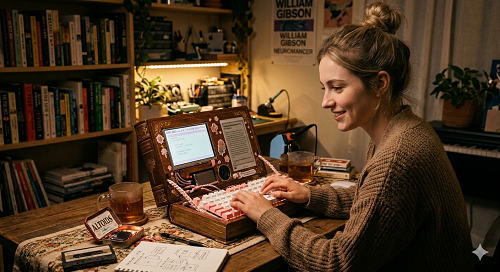
Ever feel like every laptop out there looks exactly the same? A growing number of people are quietly deciding to build their own computers instead.
A Concept from Cyberpunk Fiction, Now in the Real World
The word “cyberdeck” originally comes from William Gibson’s novel <em>Neuromancer</em> — it referred to a fictional terminal used by hackers in the story. But then people started actually building them. With the rapid advancement of small single-board computers like the Raspberry Pi, it’s become a project that anyone with a reasonable level of technical knowledge can take on.
What the Search Numbers Are Telling Us
Looking at Google Trends data, this doesn’t look like a passing fad.
- “Build a cyberdeck” hit an all-time high in search volume this year.
- “Mini keyboard” also reached an all-time high — it’s one of the essential components for any cyberdeck build.
- “Single board computer” is at its highest search interest since 2006.
What’s especially telling is the breakout surge in “what can a cyberdeck do?” searches over the past month. That’s a strong signal that it’s no longer just enthusiasts in the know — everyday people are discovering it for the first time and getting curious.
“Okay, But What Do You Actually Do With One?”
There are two use cases users seem most drawn to right now.
A Dedicated Music Production Workstation
Instead of a laptop full of distracting notifications, some builders are creating standalone environments focused purely on composition and sequencing. The recent spike in “cyberdeck for music production” searches lines up with exactly this kind of thinking.
A Reading and Writing-Only Device
Others are fitting their builds with E-ink displays to create a distraction-free space for reading and writing — no internet, no noise. “Cyberdeck for reading” searches have been climbing alongside this trend.
The Styles That Are Blowing Up Right Now
The old image of a cyberdeck was rough and military-looking. That’s changing.
- Girly style: Searches for “cyberdeck girly” and “cyberdeck for girls” have surged in the past month. It points to a shift in how people think about these builds — less about raw function, more about personal expression.
- Altoid tin build: Fitting a working computer inside a small mint tin. It’s exactly as compact and clever as it sounds.
- Book style: Hollowing out an old hardcover book and housing a computer inside. These aesthetics-first builds have been getting a lot of attention in the community.
The Core Components: What Do You Need to Build One?
If you want to start your own project, you don’t need a massive budget. A basic cyberdeck typically relies on a few core building blocks that you can source online:
- The Brain (SBC): A Raspberry Pi 4 or Raspberry Pi Zero 2 W is the standard choice. The Zero model is particularly favored for ultra-compact builds like the Altoid tin setup due to its tiny footprint.
- The Display: Depending on your goal, you can choose between a small 5-inch to 7-inch LCD touchscreen or an electronic paper (E-ink) screen if you are building a dedicated distraction-free writing deck.
- The Input: Standard mechanical keyboards are usually too large. Builders heavily utilize ultra-compact form factors, such as 40% mechanical keyboards or split-ortholinear layouts, to keep the deck highly portable.
- Power Supply: Most portable setups run unexpectedly well on a standard 5V USB power bank or a flat LiPo battery pack neatly tucked inside the chassis.
Real-World Inspiration From the Community
Before buying parts, checking out what others have done can save you a lot of trial and error. If you explore the community spaces, you will find incredibly practical advice that you won’t see in a standard manual:
- Many custom builders emphasize heat management. Packing a single-board computer into a sealed hardcover book or a tiny mint tin requires clever ventilation or small passive heatsinks to avoid thermal throttling.
- The choice of operating system matters. While standard Raspberry Pi OS works perfectly, some writers prefer ultra-minimalist Linux distributions that boot straight into a text editor without loading a heavy desktop interface.
Why Is This Happening Now?
Coming out of the pandemic, a lot of people rediscovered the satisfaction of making something with their own hands. At the same time, there’s a growing desire for tools that do exactly what you need — nothing more, nothing less. A cyberdeck can be both: something you built yourself, designed exactly to your taste, and something you can repair when it breaks.
Sources
- https://www.reddit.com/r/cyberdeck
* Images in this post were AI-generated to aid understanding.